
Some Things Last a Long Time
A few more words about 'Blue Heron'

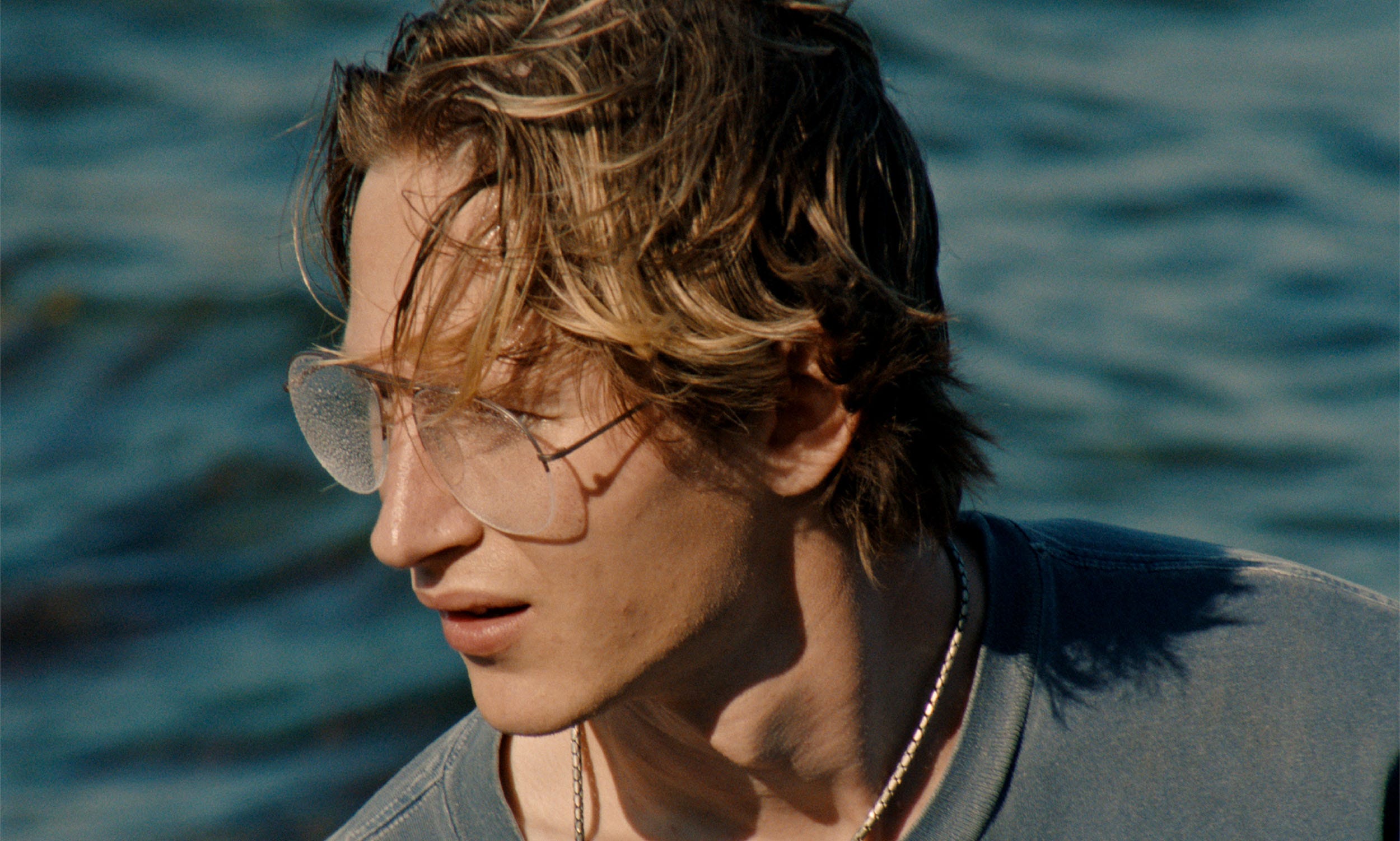
My mom mentioned something interesting the morning after we saw Blue Heron together for the second time. It was about a moment somewhere after the mid-point, just before Sophy Romvari’s film shifts into a different metaphysical space, before it all cracks. Young Sasha’s father is inside their home on Vancouver Island, camcorder in hand, recording his kids jumping on a trampoline, playing in the yard. “I thought it was longer,” she said. In the months since first seeing the movie at TIFF, my mom had often mentioned that moment in the film as the one that stuck with her most—it was big—and seeing it again, she was surprised to discover how small it really was. Memory is funny that way. Moments of personal importance grow and mutate and begin to colonize our memories until their outsized impact is matched only by the melodrama of the mind.
There is no melodrama in Blue Heron, though. Its memoiristic qualities, depicting in anecdotal scenes the emotional disintegration a family dealing with a troubled son, rest on an accumulation. Sasha’s brother Jeremy emerges as a tragic, sometimes scary sort of figure over the course of the film, whose defiant impulses build into real unease over what he might do next. He could do anything. Late in the film, it is mentioned that he once threatened to burn down the house with everyone in it. Yet again, in that description one might imagine melodrama, but the film maintains a distance, like a father recording is kids through a window, past trees and other objects. Almost every shot in the early section of the movie is peering past something, or through something, or perched at an odd omniscient angle, as though inhabiting the perspective of a nervous tourist attempting to capture an intimacy they can’t really touch. Through long lenses and a plethora of zooms—so documentary-like, and placing the film in conversation with everything from ‘70s American filmmaking to Nathan Fielder and Benny Safdie’s The Curse—dissonance pervades. “Objects in the rear view mirror may appear closer than they are.”
Cinema and memory have always been closely linked. The ability to record a moment in time, by industrial, chemical means and optical illusion, neatly corresponds to the fixed and unfixed nature of the synapses in our brain. Real and material, yet elusive, ephemeral. To journey through memory is an act of reaching, of attempting to grasp. In Blue Heron, the camera is always reaching, surveying, trying to get close to a remembered truth, but never quite making it. This is the film’s tension, where even in idyllic scenes an unease peeks through. A day at the beach, the kids playing around, sometimes dancing up to the edge of safety in the water or on high rocks, the camera zooming in and out to find the details that make up memories, the foreground regularly broken by people and other things obscuring a clear view. It feels like Jaws minus the horror. The allusion may be unintentional, but Sophy shares Spielberg’s intuitive sense of cinematic language, in which the camera becomes an embodiment of viewpoint more than mere assemblage of well-manicured mise en scène.
The same is true of the editing in the film, which operates with the assuredness of basic visual connectivity and juxtaposition, but also a willingness to test the elasticity of time and space. Following the screening at the Fox Theatre, Sophy presented her staff pick for the month: M. Night Shyamalan’s Signs. Not an obvious double-feature (unless you know Sophy’s die hard love for M Night), but watching the 2002 classic, the relationship to Blue Heron felt right. Two films, each about a family and a house. The spaces between characters explored within and around the spaces of the home, and the movement through those spaces as an intrinsic expression of time. It’s architectural filmmaking, and geographical. Blue Heron opens looking out from a high perch over a city and landscape, as though witnessing a neutral environment containing lives within it. The glimpses we get of those lives are brief, but jumping across time as only cinema can do enlivens them only further. Elisions carry weight, and when Sophy finally breaks time completely, those unseen spaces overwhelm.
In Signs, Mel Gibson plays an Episcopal priest who’s lost his faith after the horrible death of his wife. He no longer sees meaning in life. It’s all coincidence, which is to say, events carry no intrinsic value. No real emotional logic. But Signs is a religious film. Shyamalan imagines that coincidences are more than just coincidence. “Does God exist,” is a question the film cannot answer, but it makes the case for believing in the connective tissue of existence. That each thing affects the other just so, and we must only attune ourselves to the guidance of that faith. The priest’s late wife is a structuring absence, and the film is an attempt to understand that absence, to feel it, and to draw from it a means to move forward with the people we have left.
Sophy’s work has always been about moving forward, and in Blue Heron she confronts a similar absence. A lost sibling, and lost time. Largely set in the ‘90s, her evocation of the period is nostalgic, but in the Don Draper sense, “the pain from an old wound.” Its sun-kissed warmth is pervaded by mystery, longing, sadness, and decades of accumulated scarring. There are no answers in Blue Heron, only memories of what was, and a communion with the spirit of the past. When, late in the film, this communion is literalized, some greater epiphany dawns. In writing, and performance, and photography, and cutting Blue Heron opens a dialogue with the past that encompasses and overcomes the limits of language. Through a series of cuts, young Sasha witnesses her older self abscond with her brother, rescuing him for a few brief moments from the grips of time. Traipsing across rocks overlooking the sea, the two meet as human beings. Flesh and blood, able to speak to each other directly, almost jarringly so, unbound by any uncaring materiality. No longer mere remembrances of things past; time regained.