Late Eastwood #4: American Sniper
A few words about reckoning
Welcome to Late Eastwood, my tour through the late work of the still very much alive Clint Eastwood. This is a journey through the prolific director’s films since 2010, a period of his career with which I’m almost wholly unfamiliar. With his new film, Juror #2, on the horizon, I will be combing though the films leading up to it, so I can learn a bit more about what motivates a 94-year-old to keep practicing his art.
I wonder what Spielberg’s version of this would have been. It’s notable that before Steven Spielberg dropped the project, he’d had the script rewritten to over 160 pages, with added focus on an enemy sniper, called “Mustafa” in the film. You can feel the effect of that addition, and its whittling down. The Jaws director is one of our great psyhological filmmakers, using his preternatural gift for image-making and spectacle as a means with which to make real the turmoil in his characters’ minds. Clint Eastwood is not that kind of filmmaker. Not that psychology doesn’t enter into what he does, but his is a more plainspoken cinema. Moments and scenes and bits of dialogue and stray shots, all there to express direct meaning, with the complexity found by the viewer, reading between lines, making connections between ideas it’s not at all clear Eastwood ever considered. That’s not a knock either. It’s not the job of the artist to think of everything their art might be saying. The question of what American Sniper is saying was a topic of much debate back in 2014. I’m not sure it’s an answerable question.
The movie was released only a few months after Jersey Boys hit the screen, becoming Eastwood’s biggest ever box office success, and good fodder for the political culture wars of the day. If I identified Jersey Boys as perhaps the true beginning of this Late Eastwood period, that film is still marked stylistically by the string of films that came before it. American Sniper sheds even that. The colour palette is a bit more opened up, there’s a bit less insistence on darkness and sharp, glowing highlights, and there’s clarity in the way Eastwood brings scenes to life. I wonder how much of this is, in fact, a result of political alignment between subject and director. Eastwood is not some big warmonger, but he’s a patriot, and in his portrait of an American soldier he cannot help but heroicize. That he approaches this by making his hero complex and very much damaged is confusing for some who would like a more easy political read on the film—is it good, or is it Republican? Well, it’s definitely Republican, but that doesn’t mean much? What’s interesting about American Sniper, what makes it good, but also what holds it back, is its refusal to reckon with the meaning of Chris Kyle’s actions within the broader scope of American foreign policy.
I thought a lot about two things while watching American Sniper. The first was The Hurt Locker, a movie that seems to have faded almost entirely from cinephile discourse. Perhaps that’s warranted, I wouldn’t know, I haven’t seen it in well over a decade. My memory, though, is that the two great contributions of that film were its extraordinary visceral impact, built through the tightest suspense filmmaking you’ve ever seen, and the idea that the sick thrill was actually a draw for at least some of those soldiers fighting in Iraq. American Sniper seems to be playing in similar territory, though it’s never quite as thrilling as The Hurt Locker, and it doesn’t quite know what to do with meaning of the thrill. Rather, Eastwood’s film casts Kyle with a psychology just a little too simple. It was all his father, you see, who taught him to be neither a wolf, nor a sheep, but a sheepdog who comes to the aid of his flock. That’s what Kyle does in the film, when he sees the U.S. embassy bombings on the news. He enlists. The country is his flock, and he’s going to protect it. Once he’s in Iraq, his fellow soldiers are his flock, and he’s going to protect them, too.
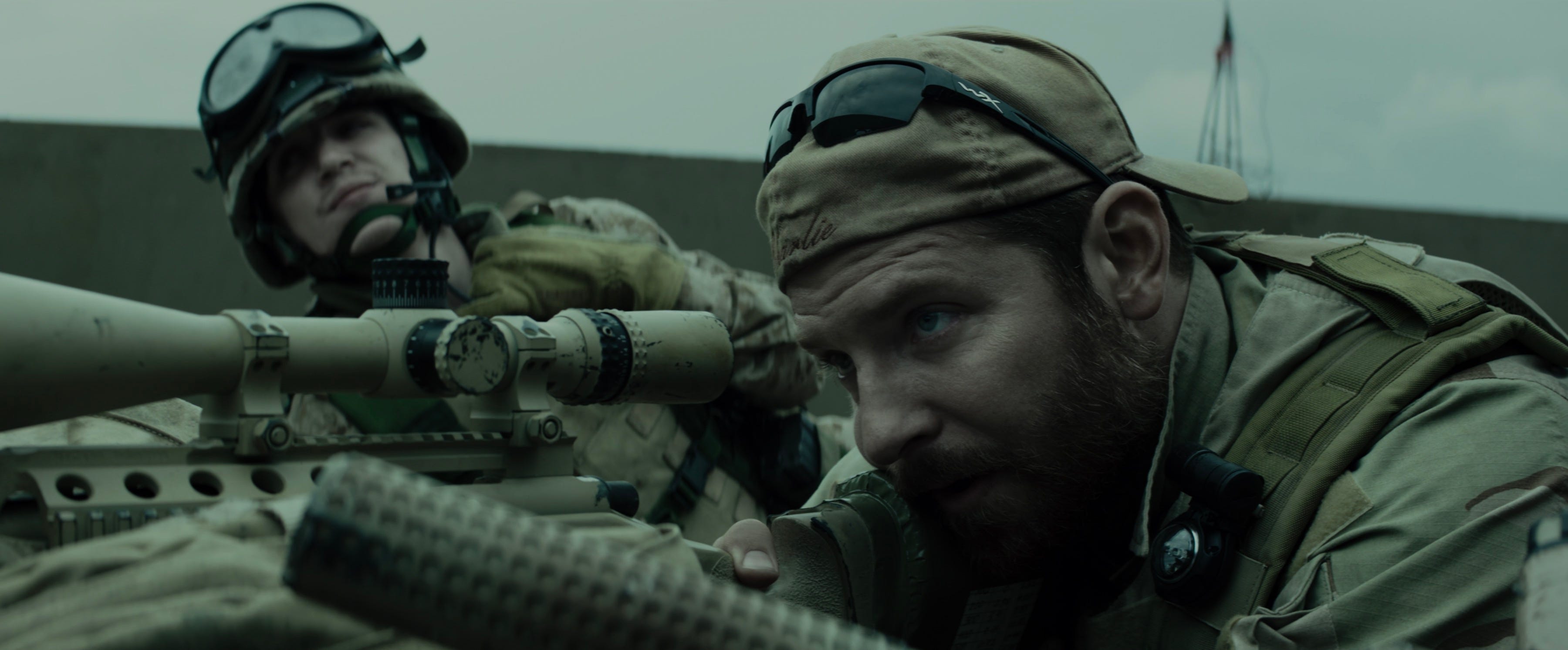
That protection comes in the form of watching over them all, eye gazing through the scope on his rifle, picking off enemies before they can pick off his brothers. When he has trouble offering that protection—he can only shoot what he sees, as people tell him—he joins troops on the ground to help out with their raids. He can’t protect everyone, though, and this is his primary source of anguish. The fact that his first confirmed kill is a child seems to bother him, but it’s unclear how he fits that action into his wider worldview. Haunting, I suppose, but never actually dealt with. Later, he almost shoots another child, but thankfully that kid doesn’t attempt to attack any soldiers, so he is spared. Kyle is shaken. The contradictions of his job do get to him, the spurious morality of war is really too much to bear. Which is why he sticks to simplicity where he can find it: everything is about protecting the flock.
Where Eastwood excels is in letting scenes be, which is to say, letting his actors be in scenes. Bradley Cooper is excellent, right from the first scene, always a human being first, with a level of lived-in naturalism he’d push even further in A Star is Born. There’s so much sponteneity in his ever movement and facial expression. There are no tics. This is a person, lived out onscreen, with Eastwood’s unfussy filmmaking allowing him all that space to breathe. The standout scene comes when Kyle is at a garage, and is recognized by a soldier whose live he saved in Iraq, played by Jonathan Groff, who makes the most of his limited screentime. Cooper, as Kyle, can hardly look Groff in the eye, acknowledging his heartfelt approach with only standard, one or two-word replies. This young soldier stands only as a reminder of all those Kyle couldn’t save.
Even an incident of PTSD-related behaviour at a barbecue leads only to a realization, while speaking with a VA doctor, that Kyle’s greatest stress is not being able to be that sheepdog. The solution is to help the veterans at home. One of those veterans goes on to murder him, a fact that caps the film, making Kyle something like a martyr in the film’s eyes. He was only ever trying to help. There’s a critique laced in there, about the Iraq War, and America’s post-9/11 overseas adventures. The way the country used people up and spit them out, conducting military operations with no clear goal, often under false pretences. But there’s no interrogation of that. Iraqis aren’t presented as much more than the “savages” characters call them, and the war itself is only ever understood as an unfortunate reality.
Which brings me to the other thing I kept thinking about while watching American Sniper. Gaza. Impossible not to, really, and what ran through my mind throughout was the narcissism of combat. It’s “our” soldiers, “our” men, protecting “our” country, and “our” interests, with no real consideration of the humanity in those fighting and dying on the other side. That would be too inconvenient to consider, to really work through. I wonder what Spielberg’s version of this movie would be been because I suspect the reason he dropped out, beyond the reported budget concerns, is that he wasn’t ultimately able to square all that, particularly in light of Kyle’s murder. He beefed up the enemy sniper character specifically to create a psychological double for Kyle. That could have been interesting. What we get in the end is just a fictional baddie for our troubled American hero to go up against. For all the complexity and tenderness present in the film, its humanity only extends so far.