
Finding Our Way Back
A few words about restoration

Hey there, friends. It’s been a while. Since TIFF, in fact. This was not intentional. I have several unpublished essays and reviews sitting in my drafts folder, none of which I was able to complete. I’ve been busy with work, so that’s a part of it, but not all of it. For example, I got stuck on a long piece I was writing a few weeks back, tangentially about One Battle After Another, but actually about the YouTube videos of art restoration I’m addicted to. The idea was clear in my mind, but it slipped away the more I wrote. Other writers can relate, I’m sure. So I put it aside, hoping the idea would coalesce once more, but it never did. So I moved on to the next, and the next, and the next, and the result is this: a post in which I describe not having written.
A word on those art restoration videos: There are a couple channels about this, but the one I stumbled on, first through TikTok, was Baumgartner Restoration. Their page has dozens and dozens of videos by this guy, Julian Baumgartner, a very calm, amiable guy who slowly, slowly, takes viewers through the process of painstakingly fixing, cleaning, and retouching old paintings. If you enjoyed the scenes of art restoration in Frederick Wiseman’s National Gallery, this is a perfect YouTube channel for you. It’s also a very ASMR-friendly channel, which I’m sure is the real source of its popularity (nearly 2 million subs!). Here’s a characteristic example.
Prepare to learn a lot about adhesives, solvents, and washi kozo paper.
In that essay I was preparing, I drew a connection between the set-by-step patience involved in art restoration and the “ocean waves, ocean waves” philosophy Sensei Sergio espouses in One Battle After Another. I doubt much more needs to be explained about that connection, which is perhaps why I wasn’t able to finish writing. But here I am, trying once again to blog, so… ocean waves, ocean waves.
While I’ve been annoyed with myself for not having published anything here, getting more real work of late provided ample distraction. The influx came after months and months and months of little to no work, and the process of that has felt a little like coming back from the dead. Revivified, but also feeling tenuous, like maybe none of this is supposed to be real. I keep waiting for the floor to fall out, on work, on journalism, maybe on the world. Good times, personally, but stressful for that very reason, and the stress isn’t exactly conducive to more personal, less motivated writing like the kind I publish here.
Yet I feel a pull toward it. I was rewatching Tenet the other day, as I often do, and somewhere around the fourth or fifth conversation in the film about the nature of action in a predetermined reality, I felt an urge to find my way back to blogging. Sometimes, you do things because they are good to do, and right. For me, for the people who do enjoy reading my ramblings for whatever reason, and for the sake of powering forward.
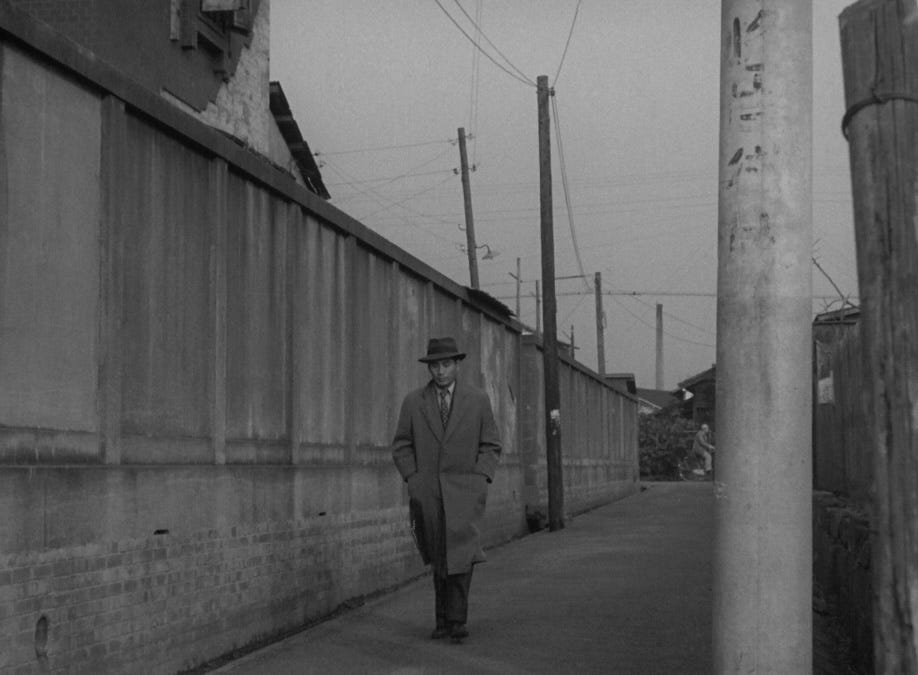
Lately, I’ve been attending TIFF Cinematheque’s big Mikio Naruse retrospective. Nowhere near a complete retrospective, TIFF has nonetheless worked with The Japan Foundation to secure a selection of 35mm prints of a fair number of his films. I’d previously only seen a couple of his films. Repast screened at the Nitrate Picture Show in 2022, and the next year, I saw the silent drama Apart from You at the Toronto Silent Film Festival, which was preceded by the short, Flunky, Work Hard!
The films TIFF has been screening are post-war, and they’ve been hitting me extra hard at the moment. Each one is a dive into Japanese domestic life, making melodrama out of pervasive social dynamics, sort of like a Japanese Sirk, though radically different in style. But just as Douglas Sirk tapped into some underlying reality in the psychology of the post-WWII American self-image, Naruse locates the psychological distress of the society that lost the war, refracted through personal relationships, all while the future marches on and the country begins its transformation into semi-westernized modernity. These are depressing films. Bleak. Suicidally so. Yet I’ve been finding them a comfort.
Naruse’s films are about people finding their way back to some sense of normal order and good living in the wake of total catastrophe. The tenets of society no longer hold the way they used to—how can they, given Japan’s conduct leading to the war and their defeat?—and human beings are left to pick up the pieces. Many cannot. Many stay steadfast in their desire to maintain the old order they knew, at least within their own narrow vantage. Others characters are still more lost than that, the foundations of their world shaken, and in the rubble there is nothing left but drudgery. Yet even this, Naruse’s films suggest, is a kind of living. It may never get better, but time continues on anyway, and that means endless opportunity for rebirth. Bleak films that somehow make the world feel richer, more beautiful, more worth living in.
So here I am, writing. Because the world is bleak, which makes finding our way back to living all the more fulfilling.